|
Từ điển Oxford Advanced Learner 8th
 have
have

have [have has had having] verb, auxiliary verb BrE [həv] NAmE [həv] BrE [əv] NAmE [əv] BrE strong form [hæv] AmE strong form [hæv]
» irregular verbs
verb (In some senses have got is also used, especially in British English.)
OWN/HOLD
1. (also have got)~ sth (not used in the progressive tenses)to own, hold or possess sth
• He had a new car and a boat.
• Have you got a job yet?
•I don't have that much money on me.
•She's got a BA in English.
CONSIST OF
2. (also have got)~ sth (not used in the progressive tenses)be made up of
• In 2008 the party had 10 000 members.
QUALITY/FEATURE
3. (also have got) (not used in the progressive tenses)to show a quality or feature
•~ sth The ham had a smoky flavour.
• The house has gas-fired central heating.
•They have a lot of courage.
•~ sth + adj. He's got a front tooth missing.
4. (also have got)~ sth to do sth (not used in the progressive tenses)to show a particular quality by your actions
• Surely she didn't have the nerve to say that to him?
RELATIONSHIP
5. (also have got)~ sb/sth (not used in the progressive tenses)used to show a particular relationship
• He's got three children.
• Do you have a client named Peters?
STH AVAILABLE
6. (also have got)~ sth (not used in the progressive tenses)to be able to make use of sth because it is available
• Have you got time to call him?
• We have no choice in the matter.
SHOULD/MUST
7. (also have got)~ sth (not used in the progressive tenses)to be in a position where you ought to do sth
• We have a duty to care for the refugees.
8. (also have got) (not used in the progressive tenses)to be in a position of needing to do sth
•~ sth I've got a lot of homework tonight.
•~ sth to do I must go— I have a bus to catch.
HOLD
9. (also have got) (not used in the progressive tenses)~ sb/sth + adv./prep. to hold sb/sth in the way mentioned
• She'd got him by the collar.
• He had his head in his hands.
PUT/KEEP IN A POSITION
10. (also have got)~ sth + adv./prep. (not used in the progressive tenses)to place or keep sth in a particular position
• Mary had her back to me.
• I soon had the fish in a net.
FEELING/THOUGHT
11. (also have got) (not used in the progressive tenses)~ sth to let a feeling or thought come into your mind
• He had the strong impression that someone was watching him.
• We've got a few ideas for the title.
• (informal)I've got it! We'll call it ‘Word Magic’.
ILLNESS
12. (also have got)~ sth (not used in the progressive tenses)to suffer from an illness or a disease
• I've got a headache.
EXPERIENCE
13. ~ sth to experience sth
• I went to a few parties and had a good time.
• I was having difficulty in staying awake.
•She'll have an accident one day.
EVENT
14. ~ sth to organize or hold an event
• Let's have a party.
EAT/DRINK/SMOKE
15. ~ sth to eat, drink or smoke sth
•to have breakfast/lunch/dinner
• I'll have the salmon (= for example, in a restaurant).
• I had a cigarette while I was waiting.
DO STH
16. ~ sth to perform a particular action
• I had a swim to cool down.
• (BrE)to have a wash/shower/bath
GIVE BIRTH
17. ~ sb/sth to give birth to sb/sth
• She's going to have a baby.
EFFECT
18. ~ sth to produce a particular effect
• His paintings had a strong influence on me as a student.
• The colour green has a restful effect.
RECEIVE
19. ~ sth (not usually used in the progressive tenses)to receive sth from sb
• I had a letter from my brother this morning.
•Can I have the bill, please?
20. ~ sth to be given sth; to have sth done to you
• I'm having treatment for my back problem.
• How many driving lessons have you had so far?
21. (also have got) (not used in the progressive tenses)~ sth doing sth to experience the effects of sb's actions
• We have orders coming in from all over the world.
HAVE STH DONE
22. (used with a past participle)~ sth done to suffer the effects of what sb else does to you
• She had her bag stolen.
23. (used with a past participle)~ sth done to cause sth to be done for you by sb else
• You've had your hair cut!
• We're having our car repaired.
24. to tell or arrange for sb to do sth for you
•~ sb do sth He had the bouncers throw them out of the club.
• (informal)I'll have you know (= I'm telling you) I'm a black belt in judo.
•~ sb + adv./prep. She's always having the builders in to do something or other.
ALLOW
25. (used in negative sentences, especially after will not, cannot, etc.)to allow sth; to accept sth without complaining
•~ sth I'm sick of your rudeness— I won't have it any longer!
•~ sb/sth doing sth We can't have people arriving late all the time.
PUT SB/STH IN A CONDITION
26. to cause sb/sth to be in a particular state; to make sb react in a particular way
•~ sb/sth + adj. I want to have everything ready in good time.
•~ sb/sth doing sth He had his audience listening attentively.
IN ARGUMENT
27. (also have got)~ sb (informal) (not used in the progressive tenses)to put sb at a disadvantage in an argument
•You've got me there. I hadn't thought of that.
SEX
28. ~ sb (slang)to have sex with sb
•He had her in his office.
TRICK
29. usually passive ~ sb (informal)to trick or cheat sb
•I'm afraid you've been had.
GUESTS
30. no passive ~ sb/sth to take care of sb/sth in your home, especially for a limited period
• We're having the kids for the weekend.
31. no passive ~ sb + adv./prep. to entertain sb in your home
• We had some friends to dinner last night.
BE WITH
32. (also have got)~ sb with you (not used in the progressive tenses)to be with sb
• She had some friends with her.
FOR A JOB
33. no passive ~ sb as sth to take or accept sb for a particular role
• Who can we have as treasurer?
Rem: Most idioms containing have are at the entries for the nouns and adjectives in the idioms, for example have your eye on sb is at eye n.
Verb forms: 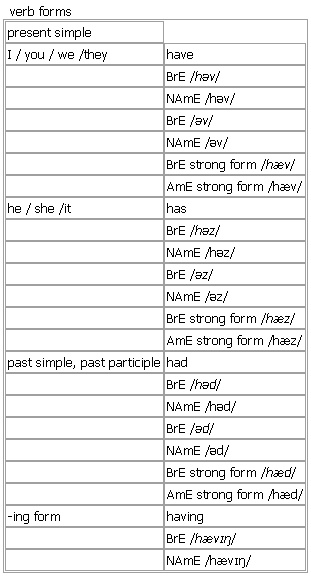
Word Origin:
Old English habban, of Germanic origin; related to Dutch hebben and German haben, also probably to ↑heave.
Thesaurus:
have verb
1. T, no passive (not used in the progressive tenses)
•He has three cars.
own • |especially BrE, especially spoken have got • |formal possess • • hold •
have/own/have got/possess a car/house
have/own/have got a company
have/have got/hold a driving licence/passport
Have or have got? Have got is common in British English, especially in spoken and informal language and especially in the present tense. In the past tense, a form of have is used more often than the forms had got and hadn't got:
•He had a house by the sea.
✗ He had got a house by the sea.
2. T, no passive (not used in the progressive tenses)
•In 2006 the party had 10 000 members.
consist of sb/sth • • make up sth • • constitute • |especially BrE, especially spoken have got • |formal comprise • • be composed of sb/sth •
The group has/has got/consists of/is made up of/comprises/is composed of ten people.
Ten people make up/constitute/comprise the group.
3. T, no passive (not used in the progressive tenses)
•They have two children.
especially BrE, especially spoken have got • |formal enjoy • • possess • • be endowed with sth • |especially written be blessed with sth • • boast •
have/have got/possess/be blessed with charm/talent/charisma
have/have got/enjoy/possess/be endowed with/be blessed with an/the ability to do sth
have/have got/be blessed with a child
4. T, no passive (not used in the progressive tenses)
•I had a cold yesterday so I wasn't at work.
suffer from sth • • get • • catch • • come down with sth • • develop • |especially BrE, especially spoken have got • |formal contract •
have/suffer from/get/catch/develop/have got/contract a/an disease/illness
have/suffer from/get/catch/come down with/have got a bug
have/suffer from/get/develop/have got/contract cancer/AIDS
5. T
•We had a terrible experience on the journey.
meet • • take • • feel • • go through sth • • run into sth • |especially written suffer • • encounter • • experience • • undergo • • receive •
have/meet/run into/encounter/experience problems
have/feel/suffer/experience/receive a/the shock
have/experience/undergo/receive treatment
6. T
•Let's have a party.
hold • • give • • host • • call • |informal throw • |formal convene •
have/hold/give/host/call/convene a conference
have/hold/call/convene a meeting
have/hold/give/host/throw a party
have/hold a conversation/debate/discussion
7. T
•I had an egg salad for lunch.
eat • • taste • |formal consume • • dine on sth • |especially written devour •
have/eat/devour a meal
have/eat your lunch/dinner
have/eat/taste/consume some meat/fruit
8. T
•She's going to have a baby.
give birth • • produce • • breed • • reproduce • |formal literary bear •
have/give birth to/produce/bear a/an child/son/daughter/heir
have/give birth to/produce a baby/litter
Have or give birth? Have is the verb most commonly used to talk about the process of being pregnant and then giving birth. Give birth is used to talk about the actual act of making a baby come out of your body
•She's going to have a baby (= she is pregnant).
• She's about to give birth (= the baby is in the process of being born).
British/American:
have you got? / do you have?
Have got is the usual verb in BrE to show possession, etc. in positive statements in the present tense, in negative statements and in questions: ▪ They’ve got a wonderful house. ◇ ▪ We haven’t got a television. ◇ ▪ Have you got a meeting today? Questions and negative statements formed with do are also common: ▪ Do you have any brothers and sisters? ◇ ▪ We don’t have a car.
Have is also used but is more formal: ▪ I have no objection to your request. ◇ ▪ Have you an appointment? Some expressions with have are common even in informal language: ▪ I’m sorry, I haven’t a clue.
In the past tense had is used in positive statements. In negatives and questions, forms with did have are usually used: ▪ They had a wonderful house. ◇ ▪ We didn’t have much time. ◇ ▪ Did she have her husband with her?
In NAmE have and forms with do/does/did are the usual way to show possession, etc. in positive statements, negatives and questions: ▪ They have a wonderful house. ◇ ▪ We don’t have a television. ◇ ▪ Do you have a meeting today? Have got is not used in questions, but is used in positive statements, especially to emphasize that somebody has one thing rather than another: ▪ ‘Does your brother have brown hair?’ ‘No, he’s got blond hair.’
In both BrE and NAmE have and forms with do/does and did are used when you are referring to a habit or routine: ▪ We don’t often have time to talk.
Example Bank:
•Have you had breakfast yet?
•He found out that he had HIV just last year.
•I don't have that much money on me.
•I had a cold yesterday and I couldn't come to work.
•I just had a sandwich for lunch.
•I'll have the salmon.
•Let's have a party to celebrate.
•Our cat has just had five kittens.
•She has a BA in English.
•She'll have an accident one day.
•She's going to have a baby.
•The car has four-wheel drive.
•We had a very interesting discussion about climate change.
•The group consists of/comprises/is made up of/is composed of/has ten people.
Idioms: ↑have done with something ▪ ↑have had it ▪ ↑have it ▪ ↑have it coming ▪ ↑have it in for somebody ▪ ↑have it in you ▪ ↑have it off ▪ ↑have nothing on somebody ▪ ↑not having any ▪ ↑what have you
Derived: ↑have somebody back ▪ ↑have somebody on ▪ ↑have somebody up ▪ ↑have something against somebody ▪ ↑have something back ▪ ↑have something in ▪ ↑have something on ▪ ↑have something on somebody ▪ ↑have something out
auxiliary verb used with the past participle to form perfect tenses
• I've finished my work.
• He's gone home, hasn't he?
•‘Have you seen it? ’ ‘Yes, I have/No, I haven't.’
•She'll have had the results by now.
•Had they left before you got there?
•If I hadn't seen it with my own eyes I wouldn't have believed it.
• (formal)Had I known that (= if I had known that) I would never have come.
Word Origin:
Old English habban, of Germanic origin; related to Dutch hebben and German haben, also probably to ↑heave.
|
|
|
▼ Từ liên quan / Related words
Related search result for "have"
|
|
